Shop Lightbringers Press
The Best Place to Begin: Year 1 Bundle
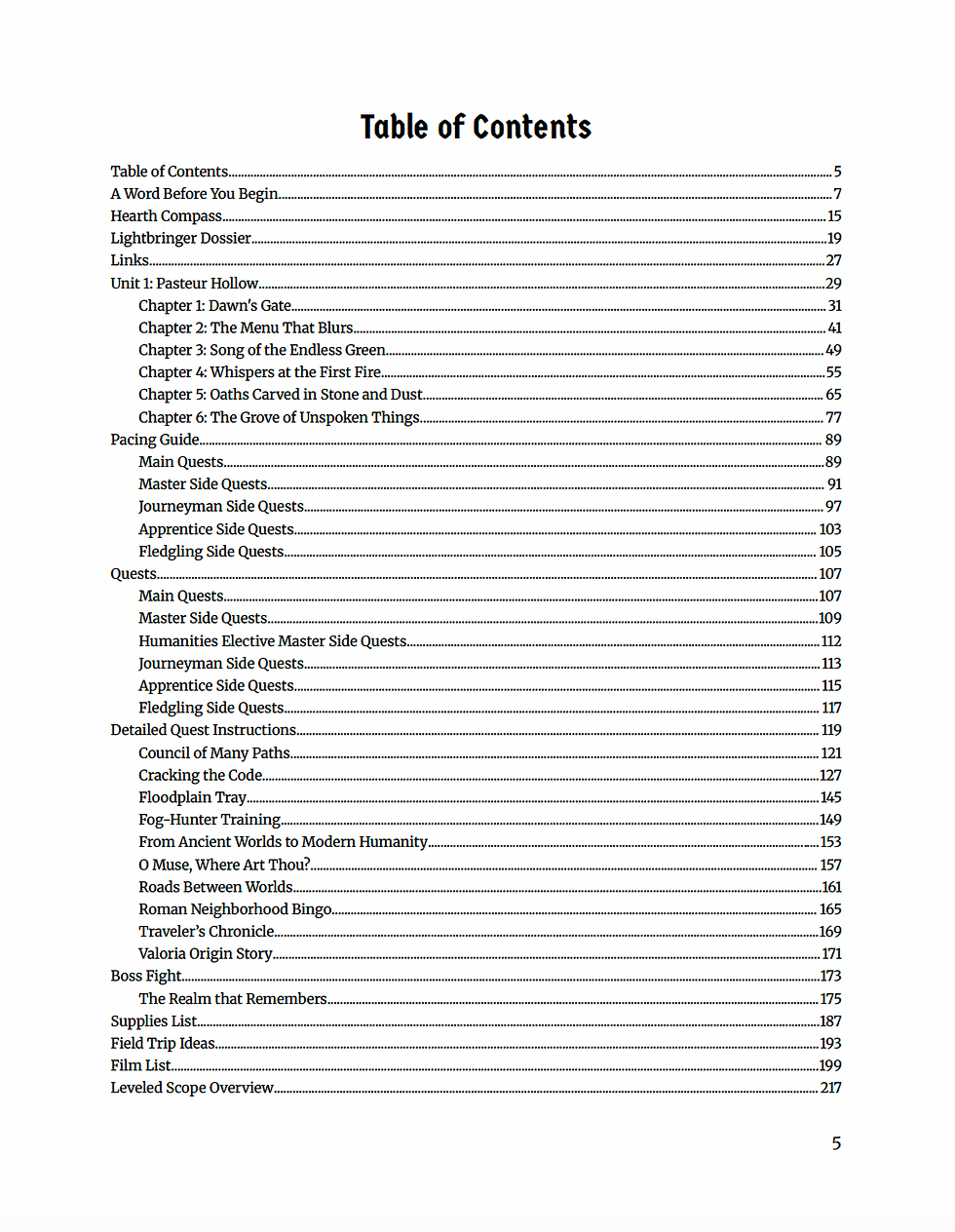
The Year 1 Bundle is the complete first-year Hearthlight experience, a connected adventure through the world of Valoria designed to guide your family through a full year of meaningful learning.
Instead of four disconnected units, Year 1 unfolds as one continuous story arc where science, history, literature, and wonder all work together.
What’s Included
-
Unit 1: Origins & Foundations
-
Unit 2: Balance & Environment
-
Unit 3: Identity & Change
-
Unit 4: Adaptation & Survival
-
Full digital curriculum downloads
-
Multi-age Side Quests and assignments
-
Parent guidance and planning support
-
High school credit-friendly structure
Start with the Full Journey
Hearthlight Curriculum
If you’re ready for a complete, connected homeschool experience, the full Hearthlight curriculum gives you everything you need to guide your family through a cohesive year of learning.
What You Get:
-
Complete story-driven units
-
Multi-age learning paths
-
Core subjects woven together
-
Guidance for parents
-
Structured progression toward high school credit
You don’t have to figure it all out. This gives you a clear path forward.


Why Families Choose Hearthlight
Hearthlight was created to feel different from traditional homeschool curriculum.
Instead of disconnected subjects and isolated themes, every unit is woven into one living world, Valoria, where stories, science, history, writing, and wonder connect together through a shared family adventure.
-
Connected fantasy-inspired story world
-
Designed for the whole family to learn together
-
Leveled assignments for multiple ages
-
High school credit-friendly structure
-
Core curriculum beyond math
-
Flexible for different homeschool styles
-
Rich interdisciplinary learning
-
Digital-first and easy to access anywhere

Explore Individual Units
All units can be done independently of the others, but for the full Hearthlight experience, we recommend doing the full year - or all four years!

Unit 1: Origins & Foundations
$59.00
Theme
How do scientific, historical, and mythic origin stories shape how we see the world?
CORE
Biology – Life & Cells
Characteristics of life; levels of organization from molecules to biosphere.
Nature of science: scientific method, experimental design, variables, data analysis.
Chemistry of life: atoms, molecules, water properties, macromolecules (carbs, lipids, proteins, nucleic acids), enzymes.
Intro to ecosystems: basic biotic and abiotic factors.
Cell theory: prokaryotic vs eukaryotic; plant vs animal cells.
Cell structures: major organelles and their functions.
Cell membrane and transport: diffusion, osmosis, active transport.
English
Read myths, epics, and short nonfiction about origins and beginnings.
Compare scientific and cultural explanations of how the world began.
Practice basic literary analysis: theme, worldview, key details.
Build expository writing skills: clear thesis, organized paragraphs, using evidence.
Practice sentence structures: simple, compound, complex.
Learn common Greek and Latin roots connected to science and history.
Practice evaluating simple sources and identifying author, purpose, and audience.
Build early speaking skills: short, clear presentations and storytelling.
World Civilizations – Origins & Foundations
Human origins, Paleolithic life, Neolithic Revolution and farming.
River valley civilizations: Mesopotamia, Egypt, Indus, early China.
Classical foundations: early Greece, Persia, early India and China.
Classical civilizations at their height: Greece, Hellenistic world, Rome, Maurya/Gupta India, Han China.
Major belief systems and their impact: Hinduism, Buddhism, Judaism, Christianity, Islam, Confucianism.
OPTIONAL INTEGRATED ELECTIVE
Intro to Humanities
What the humanities are: art, literature, philosophy, religion, music, history, culture.
Myths, epics, origin stories from many cultures.
Classical ideas: Greek philosophy and drama; Roman art, architecture, law.
Major world religious and philosophical traditions.
Art and architecture as expressions of belief and power.
Literature as a mirror of society, including marginalized voices.
Music, theater, performance across time and cultures.
Big ideas from Renaissance to modern: humanism, enlightenment, nationalism, rights movements.
Culture, identity, representation in arts and media.
Skills: close reading of texts and images; connecting past works to current issues.
Coming Soon

Unit 2: Balance & Environment
$59.00
Theme
How do energy systems keep bodies and the planet in balance?
CORE
Biology – Energy & Homeostasis
Cell cycle and mitosis; optional intro to meiosis.
Photosynthesis and cellular respiration (aerobic and anaerobic).
Homeostasis and overview of major human body systems and their interactions.
English
Read children’s/YA literature and essays about nature, environment, and health.
Study mood, imagery, and personification of natural and body systems.
Write clear informational pieces about how systems work and what happens when they are disrupted.
Use transitions to show cause and effect in writing.
Build academic vocabulary for biology, geography, and environment.
Read informational texts with graphs and charts; summarize key ideas.
Practice basic note‑taking and distinguishing fact from opinion.
Practice short, informative talks supported by simple visuals.
Geography – Earth Systems & Environments
Earth in space: latitude/longitude, seasons, time zones, basic map skills.
Landforms: plate tectonics, mountains, plains, plateaus, volcanoes, earthquakes.
Atmosphere and weather: weather vs climate, global wind belts, storms, climate zones.
Hydrosphere: oceans, currents, rivers, watersheds, lakes, groundwater, water cycle.
Biomes and ecosystems: major world biomes and climate–vegetation–wildlife links.
Environmental issues: natural hazards, resource distribution, basic sustainability ideas.
OPTIONAL INTEGRATED ELECTIVE
Health & Nutrition
Whole‑person wellness: physical, mental, social health.
Mental health basics: stress, coping skills, depression, anxiety, help‑seeking.
Healthy relationships and communication; consent and boundaries.
Human growth and basic sexuality education at an age‑appropriate level.
Substance use prevention: tobacco, vaping, alcohol, other drugs; decision‑making skills.
Nutrition basics: macronutrients, micronutrients, food labels, body image, media influence.
Physical activity and fitness for teens and long‑term health.
Disease prevention and personal health habits.
Safety, injury, and violence prevention, online and offline.
Health literacy and simple advocacy for self, family, and community.
Coming Soon

Unit 3: Identity & Change
$59.00
Theme
How do inner forces—genes and beliefs—drive people and societies to change?
CORE
Biology – Genetics & Heredity
DNA structure and function; chromosomes and genes.
Central dogma: DNA → RNA → protein (transcription and translation).
Mutations and their effects on proteins and traits.
Mendelian genetics: alleles, dominant/recessive, Punnett squares, genotype vs phenotype.
Patterns of inheritance: simple, incomplete dominance, codominance, pedigrees.
Genetic variation from meiosis and sexual reproduction.
English
Read stories and speeches about identity, family, and social change.
Analyze characterization, conflict, and how leaders argue for change.
Practice argumentative and persuasive writing on “inheritance vs ideas.”
Learn logical connectors and how to build clear arguments.
Learn to recognize basic logical fallacies.
Practice using semicolons in more advanced sentences.
Learn to evaluate sources and use simple MLA citation.
Practice structured discussions and debates using evidence.
US History – War, Cold War & Rights Movements
World War II: causes, major events, Holocaust, home front.
Early Cold War: containment, nuclear arms race, Korean War, McCarthyism.
Later Cold War: Vietnam and other key events.
Postwar prosperity, suburbanization, social change in the 1950s–1960s.
Civil Rights Movement and related movements (Chicano, Native American, women’s, LGBTQ+).
Late 20th–early 21st century: end of Cold War, globalization, 9/11, War on Terror, changing American identity.
OPTIONAL INTEGRATED ELECTIVE
Intro to Psychology
History of psychology and major perspectives.
Research methods: experiments, surveys, case studies, ethics.
Brain and nervous system basics and their link to behavior.
Sensation and perception; how we interpret the world.
Learning and memory: conditioning, observational learning, encoding and retrieval.
Lifespan development from childhood through adolescence.
Personality theories and individual differences.
Motivation and emotion: needs, goals, stress.
Social psychology: groups, conformity, obedience, prejudice, helping.
Psychological disorders, mental health, stigma, basic treatment ideas.
Coming Soon

Unit 4: Adaptation & Survival
$59.00
Theme
How do species and societies adapt in times of crisis and rapid change?
CORE
Biology – Evolution & Ecology
Evidence for evolution: fossils, anatomy, molecular data.
Natural selection, adaptation, speciation, population change over time.
Classification: domains, kingdoms, major groups and common ancestry.
Ecology: food chains/webs, energy pyramids, water/carbon/nitrogen cycles.
Population dynamics: carrying capacity, limiting factors.
Human impacts: pollution, habitat loss, climate-related issues, conservation, biodiversity.
English
Read poetry, short fiction, and songs about war, oppression, displacement, and crisis.
Analyze tone, imagery, symbolism, and how artists respond to crisis.
Practice literary-analysis writing that connects texts to historical or scientific contexts.
Learn figurative language terms and use them purposefully.
Practice advanced punctuation (em dashes, colons) for emphasis.
Analyze primary documents and propaganda for bias and techniques.
Learn early guidelines for using AI wisely in research and writing.
Practice multimodal presentations that combine text, history, and arts.
World Civilizations – War, Decolonization & Globalization
World War I: causes, consequences, interwar crises, rise of totalitarian regimes.
World War II: major events, Holocaust, effects on civilians and world order.
Decolonization and independence movements in Asia, Africa, Middle East.
Cold War: superpower rivalry, proxy wars, arms race, fall of the Soviet Union.
Recent global themes: globalization, human rights, terrorism, environment, democracy and development struggles.
OPTIONAL INTEGRATED ELECTIVE
Music History & Appreciation
Early human music: rhythm, chant, ritual, folk traditions.
Ancient and medieval music; Renaissance and Baroque music.
Classical and Romantic eras and nationalism in music.
Early jazz and blues; 20th-century popular music.
Global music traditions from multiple regions.
Film scores and media music; how music shapes mood and story.
Listening skills and building personal musical taste.
Coming Soon
What’s Included in Every Unit
I
Included
-
Main Quest lessons and story chapters for the whole family
-
Side Quests for multiple learning levels
-
Core: English, Science, and Social Studies learning
-
Open-and-go style learning
-
Integrated electives
-
Parent guidance and planning support
-
Digital PDF curriculum downloads
II
Families Provide
-
Books and read-alouds
-
Math curriculum
-
Lab and activity materials - most are household supplies
-
Access to films, documentaries, or videos where assigned
-
Printing if desired
Book and supply lists are included within the curriculum resources so families can source materials in ways that fit their budget through libraries, used books, ebooks, audiobooks, or local retailers. Outside resources are kept minimal to keep things simple and affordable.

Please read before purchasing:
-
Hearthlight is currently available as a digital download only.
-
Families may print materials at home or through a commercial printing service, if desired.
-
Interior artwork and formatting are intentionally black and white to help reduce printing costs.
-
Books and outside resources are not included in the purchase price.
-
Some units may require household materials, outside videos, films, or documentaries.
-
Math is not included and should be added separately by the family.
-
Due to the digital nature of the curriculum, all sales are final and non-refundable.
Service Discounts
We are honored to support families serving others.
-
Military families receive 20% off regular-price curriculum
-
Ministry, missionary, and church service families receive 20% off regular-price curriculum
-
Discounts are non-stackable unless otherwise stated
To receive a discount code before purchase, contact:


Devotionals
Thoughtfully designed devotional journeys that invite you to slow down, enter more deeply into Scripture, and draw nearer to Christ. Each study brings together meaningful readings, reflection prompts, and beautiful, contemplative design to help you see familiar stories with fresh eyes and carry what you discover into your own life and faith.

Come, Lord Jesus
Before Bethlehem, God’s people were already watching and waiting. Come, Lord Jesus is a 100-day journey through the Bible, following the voices of those who lived in expectation of the One who was coming. Some spoke of Him clearly. Others knew only that they were waiting for a Deliverer, a King, a Shepherd, a Priest, a Redeemer—someone who could heal what was broken, restore what had been lost, and bring God near. Moving from Eden and the patriarchs through prophets, poets, ordinary believers, and finally the people who encountered Jesus themselves, this study invites you to watch the portrait of Christ unfold across Scripture. Along the way, daily readings and reflection prompts ask not only What were they waiting for? but What does their witness teach me to expect from Him? This is an Advent journey for anyone who wants to approach Christmas with more depth and less hurry—to enter the long ache of waiting, recognize the One who came, and consider what it means to still live in hope of His coming. Who is the Jesus you’re waiting for?
Before Bethlehem, God’s people were already watching and waiting.
Come, Lord Jesus is a 100-day journey through the Bible, following the voices of those who lived in expectation of the One who was coming. Some spoke of Him clearly. Others knew only that they were waiting for a Deliverer, a King, a Shepherd, a Priest, a Redeemer—someone who could heal what was broken, restore what had been lost, and bring God near.
Moving from Eden and the patriarchs through prophets, poets, ordinary believers, and finally the people who encountered Jesus themselves, this study invites you to watch the portrait of Christ unfold across Scripture. Along the way, daily readings and reflection prompts ask not only What were they waiting for? but What does their witness teach me to expect from Him?
This is an Advent journey for anyone who wants to approach Christmas with more depth and less hurry—to enter the long ache of waiting, recognize the One who came, and consider what it means to still live in hope of His coming.
Who is the Jesus you’re waiting for?

Behold, I Have Seen
What if, instead of simply reading the Book of Mormon before Christmas, you spent 100 days listening to the people who actually witnessed Jesus Christ? Behold, I Have Seen is a Christ-centered Book of Mormon reading journey designed to carry you toward Christmas through the testimonies of those who saw Him, knew Him, waited for Him, were changed by Him, and trusted Him when everything around them seemed to fall apart. Behold, I Have Seen was created for anyone who wants to approach the Christmas season more slowly and intentionally—to quiet some of the noise, open the Book of Mormon, and come to know the Savior through the voices of those who walked the ancient Americas. For 100 days, come and see.
Before Bethlehem, God’s people were already watching and waiting.
Come, Lord Jesus is a 100-day journey through the Bible, following the voices of those who lived in expectation of the One who was coming. Some spoke of Him clearly. Others knew only that they were waiting for a Deliverer, a King, a Shepherd, a Priest, a Redeemer—someone who could heal what was broken, restore what had been lost, and bring God near.
Moving from Eden and the patriarchs through prophets, poets, ordinary believers, and finally the people who encountered Jesus themselves, this study invites you to watch the portrait of Christ unfold across Scripture. Along the way, daily readings and reflection prompts ask not only What were they waiting for? but What does their witness teach me to expect from Him?
This is an Advent journey for anyone who wants to approach Christmas with more depth and less hurry—to enter the long ache of waiting, recognize the One who came, and consider what it means to still live in hope of His coming.
Who is the Jesus you’re waiting for?

Behold, I Have Seen
What if, instead of simply reading the Book of Mormon before Christmas, you spent 100 days listening to the people who actually witnessed Jesus Christ?
Behold, I Have Seen is a Christ-centered Book of Mormon reading journey designed to carry you toward Christmas through the testimonies of those who saw Him, knew Him, waited for Him, were changed by Him, and trusted Him when everything around them seemed to fall apart.
Behold, I Have Seen was created for anyone who wants to approach the Christmas season more slowly and intentionally—to quiet some of the noise, open the Book of Mormon, and come to know the Savior through the voices of those who walked the ancient Americas.
For 100 days, come and see.